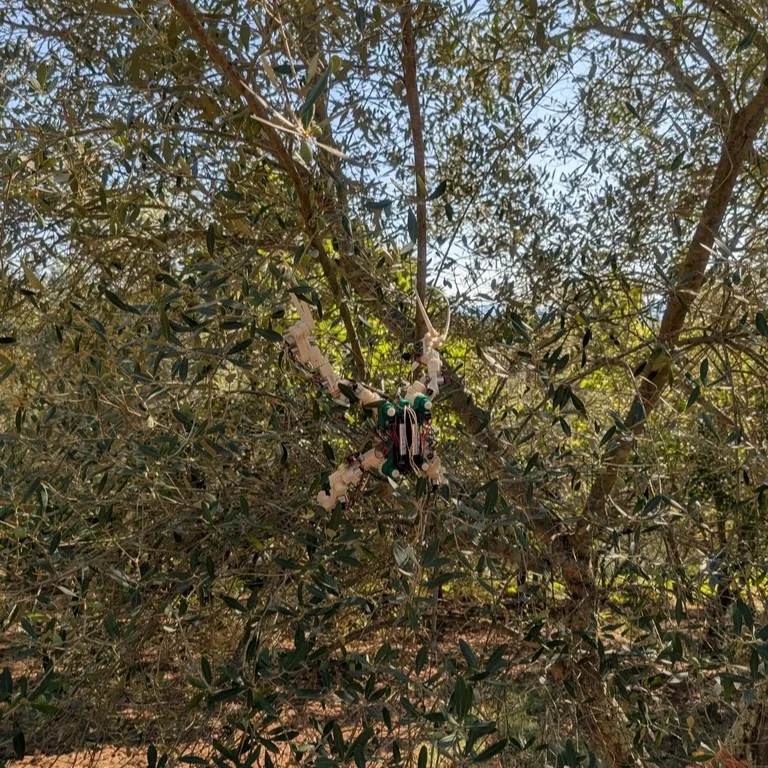
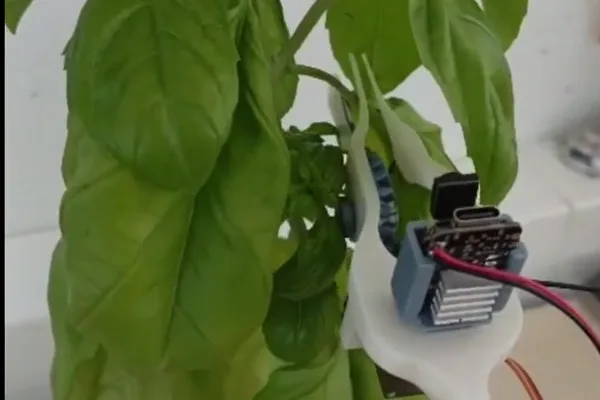
Madglove builds a functional orthosis that gives people with reduced hand mobility their grip back at home. They needed to measure whether it was working — motion data, from a glove whose mechanics could not be disturbed, on a battery small enough that nobody notices it.
The constraintSensors that do not interfere with the glove’s mechanics, powered by a battery, small enough to wear all day.
What we builtA series of prototypes ending in an interconnected sensor device with on-device movement classification — battery, microcontroller, and sensor small enough to sit on a finger ring, in a 3D-printed case we designed.
PlusA computer-vision tool that tracks hand and finger joint landmarks, so physiotherapists can measure a patient’s range of motion instead of estimating it.
AlsoWe sat in the design-for-manufacturing conversations with suppliers on behalf of a non-technical team.
With Mycofarming BV · two years · cleantech, co-funded by the Province of Noord-Holland
Mycofarming uses mycelium to filter pollutants out of water. They were building the biology; nobody was measuring it. We built the sensing, indoors and outdoors, and the dashboards that turned it into something you can look at.
IndoorsRaspberry Pi nodes in MycoLab growth chambers over secure Wi-Fi, with BLE between them: total dissolved solids in the water, plus CO2, temperature, and humidity in the air.
CamerasRaspberry Pi Camera Module 3 with the infrared filter removed, in a 3D-printed enclosure we designed with active cooling — so mycelium growth and water colour are visible beyond what the eye sees.
OutdoorsLoRaWAN probes for soil moisture, conductivity, and temperature on mushroom blocks sitting in open water streams. LoRaWAN because it covers effectively all of the Netherlands and the probes have to stay on.
HardwareMiniaturised MycoTowers — 3D-printed filtration columns with automated pumps for continuous recirculation — to test at bench scale what runs in an industrial plant.